FREE Sketch Umpire Icon: A Practical Resource for Designers and Developers
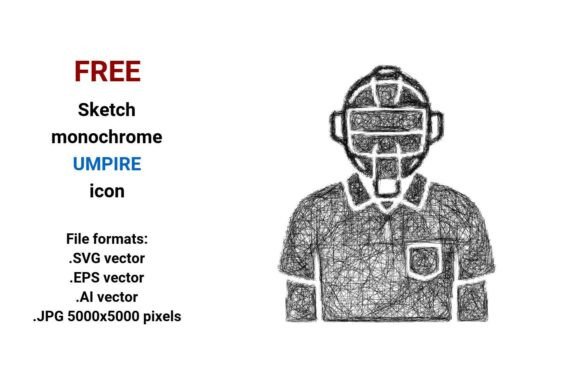
The FREE Sketch Umpire Icon is a hand-drawn, black-and-white visual representation of a baseball umpire—designed not as a photorealistic depiction, but as a stylized, sketchy line art element. It’s intentionally minimal, expressive, and rooted in analog drawing aesthetics: think light hatch marks, subtle imperfections, and visible pencil-like strokes. Unlike polished flat icons or 3D renders, this set prioritizes personality and human touch—making it especially useful where warmth, creativity, or editorial tone matters.
What Makes This Icon Distinctive?
Its distinction lies in both form and function. First, the sketch aesthetic communicates approachability and authenticity—valuable in educational platforms, community apps, or branding that wants to avoid corporate sterility. Second, it ships in four native formats: .SVG, .EPS, .AI, and .JPG (5000×5000 pixels). That combination covers nearly every production need: vector scalability for logos or large-format print, editable source files for designers using Adobe Illustrator, and a high-resolution raster version for web use where SVG isn’t supported or when pixel-perfect rendering across legacy systems is required.
Unlike many generic “umpire” or “baseball official” icons found in stock libraries—which often default to stiff silhouettes or overly literal uniforms—the FREE Sketch Umpire Icon leans into gesture and suggestion. A raised hand implies a call; a tilted cap and relaxed stance suggest presence, not rigidity. It works equally well as a baseball referee identifier in a sports app, a game official marker in tournament software, or a visual anchor in instructional material about baseball rules.
How It Compares Across Formats and Styles
Vector formats (.SVG, .EPS, .AI) preserve infinite scalability without quality loss—ideal for responsive UIs, signage, or merchandise. The .SVG file is lightweight and embeddable directly in HTML, supporting CSS styling and accessibility attributes like aria-label. The .EPS and .AI files retain layer structure and editable paths, making them suitable for professional designers who need to adjust stroke weight, reposition elements, or integrate the icon into larger brand assets.
The included .JPG offers flexibility where vector support is limited—such as email clients, older CMS templates, or certain presentation tools. At 5000×5000 pixels, it remains crisp even when scaled down for thumbnails or enlarged for banners. However, unlike vector versions, it cannot be recolored programmatically or resized infinitely without potential aliasing or blurring at extreme enlargements.
Compared to other sketch-style resources—like broad UI kits or subscription-based icon libraries—the FREE Sketch Umpire Icon stands out for its narrow focus and ready-to-use specificity. You’re not sifting through hundreds of icons to find one that fits a baseball context. You get exactly what’s needed: a single, well-executed, context-aware umpire vector with consistent line weight, balanced negative space, and intentional imperfection.
When This Icon Fits—and When It Might Not
This resource excels in scenarios where tone and recognition matter more than strict realism. For example:
- A youth baseball league’s mobile app uses the icon as a navigation button labeled “Rules & Calls”—its sketch style aligns with the app’s friendly, non-intimidating interface.
- An online coaching platform includes it in a lesson module about “Understanding the Umpire’s Role,” where the hand-drawn quality supports an informal, mentor-like voice.
- A small business creates branded merchandise (tote bags, notebooks) featuring minimalist baseball motifs—the icon scales cleanly from 2 inches to 2 feet without needing redrawn assets.
It may be less appropriate where neutrality, authority, or universal legibility is paramount. In official league documentation, broadcast graphics, or regulatory materials, a more standardized, high-contrast, or emblematic symbol might communicate formality more effectively. Similarly, if your project requires color variation (e.g., team-specific uniforms), the black-and-white nature means manual recoloring—or pairing with complementary design elements—is necessary.
Usability Considerations Beyond Format
As a sketch umpire button or web icon, usability depends on context. Its line-based construction works best at medium to large sizes (48px and up). At very small scales (e.g., 16px favicon use), fine details like hatch marks or cap brim texture may blur or disappear—so it’s not ideal for tiny interface elements without simplification.
Contrast is another practical factor. Being monochrome, it relies on background contrast for visibility. On dark backgrounds, it performs well without modification; on light or busy backgrounds, a subtle drop shadow or solid fill behind the icon may improve readability—especially in accessible interfaces where WCAG contrast ratios must be met.
From a branding perspective, its “sketchy” quality signals creativity and informality—not regulation or enforcement. That makes it a strong match for startups, educational tools, or fan communities—but potentially misaligned with organizations emphasizing strict adherence to protocol, such as professional league compliance departments or arbitration services.
Design Integration and Real-World Flexibility
Because it’s delivered as both vector and high-res raster, integration paths are straightforward. Web developers can inline the SVG directly, apply hover effects via CSS, or bundle it with icon fonts. Designers working in Figma or Sketch can import the .SVG and convert it to components with variants (e.g., active/inactive states). Print teams receive production-ready .EPS or .AI files compatible with standard prepress workflows.
The icon also functions well as part of a broader sketch ui kit—paired with similarly styled icons for “bat,” “glove,” “scoreboard,” or “pitch count.” Its consistent line weight, spacing, and visual rhythm help maintain cohesion across interfaces without requiring custom illustration work.
That said, consistency requires intention. If your product already uses bold, geometric icons or photorealistic illustrations, dropping in a sketch-style umpire icon could create visual dissonance unless supported by broader stylistic adjustments—like introducing subtle texture overlays or unifying stroke treatments across all assets.
Making an Informed Choice
Choosing the FREE Sketch Umpire Icon isn’t just about needing *an* umpire graphic—it’s about selecting a design language that supports your message. Ask yourself:
- Does the sketch aesthetic reinforce the tone I want—approachable, instructive, creative?
- Do I need true scalability across devices, outputs, and future use cases? (If yes, prioritize the vector files.)
- Will users recognize it instantly as representing a baseball referee or game official, even without labels?
- Is my audience likely to associate hand-drawn visuals with trustworthiness and clarity—or with informality and lack of authority?
If most answers point toward expressiveness, adaptability, and contextual fit, then this icon delivers tangible value without licensing cost or usage restrictions. If your needs center on strict standardization, multicolor application, or integration into highly regulated environments, exploring complementary or alternative assets—such as official league-branded symbols or neutral silhouette sets—may be more appropriate.
In short: the FREE Sketch Umpire Icon is a focused, production-ready tool—not a one-size-fits-all solution, but a thoughtful option for those who value both craft and clarity.