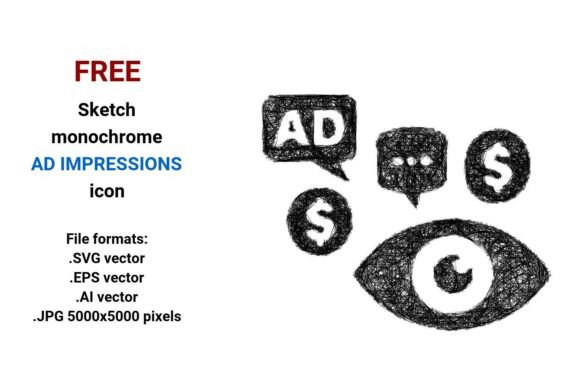
FREE Sketch Ad Impressions Icon: A Versatile, Scalable Resource for Designers and Marketers
If you're building a dashboard, crafting a pitch deck, designing an analytics UI, or illustrating an ad-tech presentation, the FREE Sketch Ad Impressions Icon is more than just a visual—it’s a flexible storytelling tool. Unlike generic stock icons, this sketch-style asset communicates authenticity, approachability, and creative intent—while delivering precise meaning: ad views, advertising impressions, or simply impressions. And because it’s available in four professional file formats—.SVG vector, .EPS vector, .AI vector, and high-res .JPG (5000×5000 pixels)—it adapts seamlessly whether you’re coding a responsive web component or printing a client-facing report.
Why “Sketch” Style Matters in Real-World Projects
A sketch ad impressions icon doesn’t just represent data—it signals tone. That hand-drawn, slightly rough, black-and-white aesthetic says “this isn’t corporate boilerplate; it’s thoughtful, human-centered design.” You’ll see it shine in contexts where polish might feel cold or disconnected:
- Startup pitch decks: Investors respond well to visuals that balance professionalism with personality. A minimal, sketched ad impressions icon next to your CPM or reach metrics feels grounded—not overproduced.
- E-commerce analytics dashboards: When designers integrate this icon into UI kits for Shopify or WooCommerce plugins, users instantly recognize the “views” function—even before reading labels. Its line art clarity holds up at small sizes, and its isolated, monochrome composition ensures legibility against busy backgrounds.
- Educational slides and workshops: Teaching digital marketing? A presentation sketch icon helps learners associate abstract terms like “advertising impressions” with tangible, memorable imagery—especially when paired with real campaign examples (“This icon represents the 247K impressions our Instagram carousel received last week”).
- Printed reports and investor updates: The 5000×5000 JPG version prints crisply on letterhead or large-format presentations, while the vector files scale effortlessly for banners or trade show signage—no pixelation, no rework.
Who Benefits—and How They Use It Differently
The same FREE sketch black and white ad impressions icon serves very different needs across roles—and that’s by design.
UI/UX designers lean into the scalable, vector ad impressions button variants (.SVG, .AI, .EPS) to build consistent icon systems. Because it’s built with clean paths and minimal anchor points, it imports smoothly into Figma, Adobe XD, or Sketch—no broken strokes or rendering quirks. Many use the outline and hatch details as subtle texture cues, reinforcing hierarchy without adding visual noise.
Digital marketers often grab the JPG version for quick drag-and-drop use in Google Slides or Canva presentations—especially when prepping client briefings. Its rough sketch icon quality makes performance charts feel less intimidating and more collaborative. One agency we spoke with uses it consistently in their “Impressions vs. Clicks” comparison slides—always in black-and-white, always left-aligned beside key stats—to create instant visual rhythm.
Frontend developers appreciate the SVG format for inline embedding. Since it’s pure vector code (no embedded raster), it loads fast, respects dark mode via CSS fill properties, and scales responsively without JavaScript workarounds. Bonus: it works beautifully as an ad impressions button in React or Vue components—just wrap it in a and add hover states.
Content creators and educators use the handdrawn ad impressions icon to break up text-heavy blog posts or email newsletters. Placed beside definitions—“Advertising impressions: the number of times your ad was displayed”—it boosts retention. Readers remember the visual cue long after skimming the paragraph.
What to Consider Before You Download and Apply
This icon is intentionally minimal—but minimal doesn’t mean universal. Here’s what seasoned users keep in mind:
- Color context matters: While the black-and-white version offers maximum flexibility, avoid placing it directly over busy patterns or low-contrast grays. If your background is dark, invert it—or use the SVG to recolor via CSS. The vector formats make this effortless.
- Consistency > novelty: Don’t mix sketch-style icons with ultra-sleek flat icons in the same interface. If you choose this sketch ad impressions icon, extend the style across related assets (e.g., a sketch button for “Refresh Data” or a scribble icon for “Notes”). Cohesion builds trust.
- File format fit: Need to edit paths or layers? Go with .AI or .EPS. Prepping for web? .SVG is ideal. Sharing with non-designers who only use PowerPoint? The high-res JPG saves time and avoids font/linking issues.
- It’s not a chart substitute: This is an icon, not a data visualization. Use it to label, navigate, or symbolize—not to convey trends, comparisons, or thresholds. Pair it with actual numbers, graphs, or annotations for full impact.
Strengths That Stand Out—And One Practical Limitation
What makes this ad impressions icon especially useful is how it bridges disciplines. Its curved, organic lines soften technical topics. Its scalable nature means one download solves multiple output needs. And because it’s truly free, there’s zero friction to test it in your next project—even if you’re prototyping on a tight deadline.
That said, it’s intentionally monochrome and minimal. If your brand guidelines require strict color matching (e.g., a specific Pantone blue), you’ll need to adjust it manually—or pair it with a complementary colored element nearby (like a badge or accent bar). It’s not a limitation of quality—it’s a design choice that prioritizes adaptability over prescriptive styling.
More Than Just an Icon—A Design Element With Purpose
Think of the FREE Sketch Ad Impressions Icon as a quiet collaborator: it doesn’t shout, but it clarifies. Whether you’re explaining ad views to a first-time advertiser, labeling a “Daily Impressions” toggle in a SaaS dashboard, or sketching wireframes for a new analytics tool, this asset carries meaning without clutter. It’s part of a growing toolkit of ui sketch icons that treat interface elements not as decoration, but as functional, empathetic communication.
Its strength lies in what it doesn’t do: it doesn’t distract, overcomplicate, or date quickly. No gradients. No shadows. No forced realism. Just clear, scalable, human-made form—ready to support your message, not compete with it.