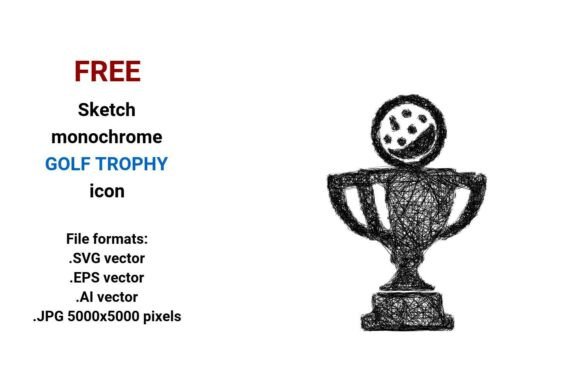
FREE Sketch Golf Trophy Icon
If you're designing a golf tournament landing page, building a sports-themed app interface, or preparing award materials for a local club championship, finding the right visual shorthand matters. The FREE Sketch Golf Trophy Icon isn’t just another clipart download — it’s a purpose-built, hand-drawn vector asset designed for clarity, flexibility, and professional polish. What sets it apart is its intentional sketch aesthetic: loose but intentional line work, subtle texture hints, and clean negative space — all preserved across four fully editable formats: .SVG, .EPS, .AI, and high-res .JPG (5000×5000 px).
Why “Sketch” Isn’t Just a Style — It’s a Functional Choice
Many designers reach for generic trophy icons only to realize later that they clash with branding that values authenticity, approachability, or creative energy. A polished 3D trophy may feel corporate or cold beside a hand-lettered event name or a rustic course photo. That’s where the sketch golf trophy icon shines: it signals craftsmanship without sacrificing scalability. Because it’s built as a vector image — defined by mathematical paths, not fixed pixels — you can scale it from a 16-pixel UI button to a 48-inch banner without blurriness or pixelation. Unlike raster-only downloads, this means one file works for web, print, embroidery digitizing prep, or even laser-cut signage templates.
A Common Misstep: Assuming “Free” Means “Ready for Production”
Not all free icons are production-ready — especially when labeled “sketch” or “handdrawn.” Some lack consistent stroke weight, contain ungrouped layers, or use embedded raster effects that break in older design software. Others include non-standard fonts or unconverted text, making them impossible to edit in Illustrator unless you own the same font license. Worse, some “free” sources embed tracking pixels or require attribution in ways that conflict with commercial use — a surprise when your client launches a paid golf championship website.
With the FREE Sketch Golf Trophy Icon, you avoid those pitfalls because it ships cleanly: no hidden layers, no linked assets, no external dependencies. All strokes are outlined. All colors are flat (no gradients or transparency that might render inconsistently). And crucially, it’s licensed for both personal and commercial use — no fine-print surprises when you add it to a tournament registration button or email campaign header.
Format Confusion: Why You Need More Than Just JPG
That 5000×5000 JPG is excellent for mockups, social media banners, or presentations — but it’s a dead end if you need to recolor the trophy for dark mode, adjust line thickness for mobile UI, or export at multiple sizes for responsive design. Relying solely on the JPG means you’ll eventually hit quality limits or waste time redrawing elements manually.
Here’s what each format actually does for you:
- .SVG: Ideal for websites and apps — lightweight, supports CSS styling, accessible via
- .EPS: Best for legacy print workflows and compatibility with older Adobe or Corel applications.
- .AI: Fully editable in Adobe Illustrator — change anchor points, adjust sketch texture, or isolate parts (e.g., just the cup or base) for custom animations.
- .JPG: High-resolution fallback for quick placement where vectors aren’t supported — like certain CMS editors or PowerPoint decks.
Using only one format narrows your options. Smart users grab all four — not as redundancy, but as insurance against workflow friction down the line.
What to Check Before You Download (or Embed)
Before adding any golf trophy icon to your project, ask yourself three things:
- Is the stroke weight balanced? Too-thin lines vanish on small screens; too-heavy ones overwhelm minimalist layouts. This icon uses a deliberate 1.2–1.8 pt variable weight — readable at 24 px, expressive at 200 px.
- Does it align visually with your other UI elements? If your site uses rounded corners and soft shadows, a sharp, angular trophy may jar. This sketch version leans into organic flow — making it easier to pair with hand-drawn buttons, chalkboard-style headers, or watercolor backgrounds.
- Can it communicate “award” without clutter? Some icons overcomplicate with ribbons, flags, or exaggerated shine. This one uses minimal line art sketch principles: just enough detail to read as a trophy, nothing more. That makes it faster to recognize — critical for mobile users scanning a tournament results page.
Beyond Decoration: Real Use Cases That Work
This isn’t just for “pretty” graphics. Designers and marketers report strong performance in these practical scenarios:
- Golf championship trophy buttons on registration forms — the sketch style feels celebratory but not childish.
- Award category badges in digital leaderboards — SVG allows hover color shifts without loading new assets.
- Print-ready certificates where the EPS version ensures crisp output on letterpress or foil-stamped paper.
- Educational infographics for junior golf programs — the handdrawn look lowers perceived complexity for young learners.
One freelance designer used the sketch golf trophy icon as the central element in a nonprofit’s “Drive for Donations” campaign — pairing it with real donor names instead of scores. Because the icon felt human and unpolished, it reinforced the message: “This isn’t about perfection. It’s about participation.”
Final Thought: Scalable Simplicity Is Rare — and Valuable
In a world of AI-generated assets and overdesigned templates, a well-crafted FREE Sketch Golf Trophy Icon stands out precisely because it doesn’t try to do everything. It doesn’t mimic photorealism. It doesn’t force unnecessary details. Instead, it delivers clarity, consistency, and quiet confidence — whether you’re a small business owner updating your club’s website or a UX designer building a golf analytics dashboard.
What makes it truly useful isn’t just that it’s free — it’s that it’s thoughtful. Every curve, every gap in the line work, every exported format reflects an understanding of how real people use icons: not as isolated art, but as functional, flexible, and quietly meaningful parts of larger systems.