Why the FREE Sketch Tennis Serve Icon Is Reshaping Visual Communication for Creators and Brands
In today’s fast-paced digital landscape, clarity, authenticity, and speed define effective visual communication. Whether you’re a UI/UX designer building a sports analytics dashboard, a marketer launching a tennis coaching app, or an entrepreneur developing a fitness SaaS platform—the right icon doesn’t just decorate an interface. It signals intent, conveys action, and builds immediate recognition. That’s where the FREE Sketch Tennis Serve Icon stands out—not as a generic asset, but as a purpose-built, context-aware design element engineered for real-world creative workflows.
What Exactly Is the FREE Sketch Tennis Serve Icon?
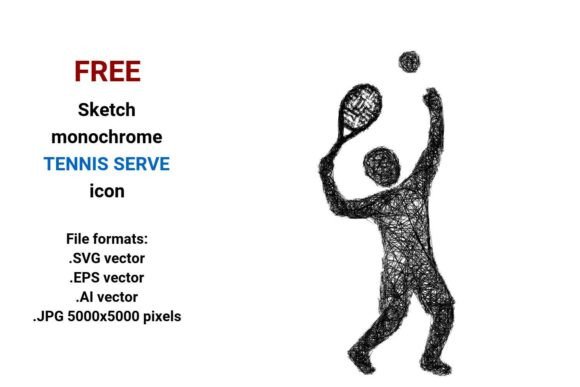
The FREE Sketch Tennis Serve Icon is a hand-drawn, monochrome vector illustration capturing the dynamic motion of a tennis serve—specifically the serve action: the coiled stance, upward swing, and moment of contact. Unlike photorealistic or overly stylized alternatives, this icon embraces intentional imperfection: subtle line variation, visible pencil texture, and expressive curves that echo human gesture. It’s not “polished to oblivion.” It’s drawn to communicate.
Available in four production-ready formats—.SVG vector, .EPS vector, .AI vector, and a high-resolution .JPG (5000×5000 pixels)—it bridges conceptual authenticity with technical flexibility. As a vector image, it’s built from mathematical paths rather than pixels. This means it scales flawlessly—from a 16px favicon to a 48-inch trade show banner—without blurring, distortion, or quality loss. Designers retain full editability in Illustrator or Figma; developers embed the SVG directly into HTML for crisp, lightweight rendering; marketers drop the JPG into pitch decks or social ads without worrying about resolution constraints.
Beyond Aesthetics: The Strategic Shift Toward Human-Centered Visual Language
Across industries, there’s a quiet but accelerating pivot away from sterile, algorithmically optimized visuals—and toward what we might call human-resonant design. Consumers and users increasingly associate over-refined, AI-generated, or stock-heavy interfaces with distance, impersonality, or even distrust. In contrast, sketch-style icons like the FREE sketch black and white tennis serve icon signal intentionality, craft, and approachability.
This isn’t nostalgia—it’s strategy. Consider how fitness apps now use hand-drawn icons to soften data intensity. Or how SaaS platforms integrate scribble-inspired UI elements to make complex workflows feel more intuitive and less intimidating. The sketch tennis serve icon fits seamlessly into this paradigm: its rough sketch icon quality adds warmth to technical contexts (like biomechanics dashboards), while its clean outline and minimal composition ensure legibility across devices and accessibility standards.
Why “Serve Action” Matters More Than Ever
The word serve carries layered meaning in both sport and software. In tennis, it’s the only shot fully controlled by the player—the opening move that sets tempo, asserts dominance, and defines rhythm. In product design and marketing, “to serve” is equally foundational: serving users, serving insights, serving value. That duality makes the serve action a powerful visual metaphor—not just for sports interfaces, but for onboarding flows, CTA buttons (“Serve Your Goals”), or even internal team dashboards tracking performance metrics.
A tennis serve button built from this icon doesn’t merely label functionality—it invites participation. Its hand drawn sketch quality implies invitation, not instruction. Its curve and pen stroke suggest motion and readiness. And because it’s delivered as a vector tennis serve button asset, it integrates natively into design systems without compromising fidelity or load time.
Fitting Into Evolving Creative Workflows
Today’s creators operate across tools, timelines, and teams. A freelance UI designer may hand off assets to a developer using Figma, while a brand strategist drops the same icon into a Notion brief or Canva presentation. The FREE Sketch Tennis Serve Icon anticipates these realities:
- Designers use the .AI and .EPS files to adjust stroke weight, recolor for dark mode, or combine with other handdrawn tennis serve icon assets in a cohesive library.
- Developers embed the .SVG inline—enabling CSS-driven interactivity (e.g., hover animations that trace the serve arc) or responsive scaling without additional HTTP requests.
- Marketers leverage the .JPG for high-fidelity mockups, email headers, or printed workshop materials—knowing it retains clarity at any size.
- Entrepreneurs repurpose the icon across touchpoints: as a web icon in a mobile app, a template element in a pitch deck, or even a watermark on instructional videos—all without licensing friction or attribution overhead.
This cross-functional utility reflects broader shifts in creative tooling: the line between “design asset” and “functional component” continues to blur. Icons are no longer decorative afterthoughts—they’re modular, semantic units in a living design system. The sketchy icon aesthetic, once reserved for mood boards, now anchors production-grade interfaces precisely because it balances personality with precision.
Contextual Relevance Across Industries
It’s tempting to pigeonhole a tennis icon as niche—but its underlying design logic extends far beyond the court.
In healthtech, a drawn tennis serve can visualize kinetic chain analysis or rehabilitation progress—its gestural clarity making biomechanical concepts instantly graspable. In edtech, it serves as a visual anchor in interactive lessons about physics (angular momentum, torque, center of mass) or sports psychology (focus, timing, ritual). For coaching platforms, the icon becomes part of a scalable visual language—paired with tennis serve icons for forehand, backhand, or volley to build consistent, scannable navigation.
Even outside sports: startups building habit-tracking tools borrow the serve action metaphor to represent “initiating your routine”—leveraging the icon’s inherent sense of agency and momentum. Its monochrome sketch icon neutrality ensures it adapts to brand palettes without visual conflict, while its clean structure maintains hierarchy in dense information environments.
Why Professionals Are Prioritizing This Kind of Asset Now
Three converging forces explain the rising demand for assets like the FREE sketch black and white tennis serve icon:
- Speed-to-trust: Users decide within seconds whether a digital experience feels credible and human. A thoughtfully sketched icon signals care and craftsmanship faster than paragraphs of copy.
- Adaptability at scale: With remote collaboration, global audiences, and multi-device usage as defaults, designers need assets that perform identically in a dark-mode iOS app and a print-ready investor report. Vector + high-res JPG delivers that.
- Authentic differentiation: In saturated markets—from fitness apps to sports analytics—the ability to express brand voice through micro-interactions (like a tennis serve button) creates tangible distinction. A pencil-drawn serve isn’t just functional—it’s memorable.
This isn’t about chasing trends. It’s about aligning visual choices with how people actually process information: quickly, emotionally, and contextually. The FREE Sketch Tennis Serve Icon works because it meets users where they are—visually literate, time-constrained, and attuned to subtle cues of authenticity.
Looking Ahead: Design as Dialogue, Not Decoration
The future of interface design lies in assets that do more than identify—they invite, clarify, and connect. The FREE Sketch Tennis Serve Icon exemplifies this evolution: a digital artifact rooted in hand drawn sketch sensibility, engineered for technical rigor, and deployed with strategic intent. It reflects a maturing understanding that every pixel, curve, and stroke participates in a larger conversation—with users, with teams, and with the values a brand chooses to embody.
For professionals building products, campaigns, or platforms where clarity, motion, and human resonance matter, this icon isn’t just “free.” It’s foundational.