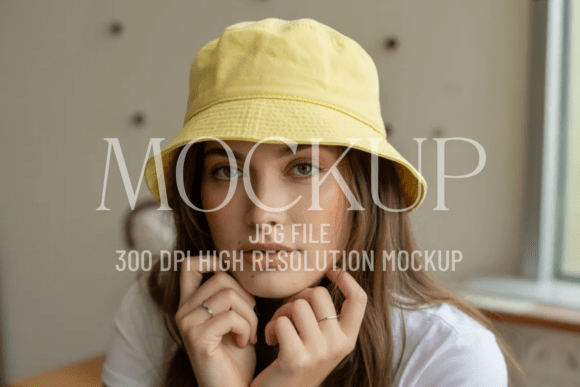
Pastel Yellow Bucket Hat Mockup
A Pastel Yellow Bucket Hat Mockup isn’t just another digital prop—it’s a quiet but powerful tool for designers, small business owners, and content creators who want their visuals to feel intentional, calm, and current. That soft, sun-warmed hue—neither too bright nor too muted—pairs effortlessly with minimalist branding, wellness campaigns, lifestyle photography, or even educational materials. When applied thoughtfully, this mockup helps your design speak before a single word is read.
Why “Minimal” Isn’t Just a Style Choice—It’s a Strategic One
Many assume “minimal mockup” means stripped-down or basic. In reality, it signals intentionality: no distracting shadows, no forced angles, no cluttered backgrounds. The Premium Minimal Mockup you’re considering delivers exactly that—a clean, 300 DPI JPG file with zero text, tags, or watermarks. That blank canvas matters more than it sounds. It gives you full control over color harmony, typography placement, and visual hierarchy—without fighting against someone else’s aesthetic choices.
But here’s where things go sideways for some users: they treat the mockup like a finished product instead of a presentation layer. You wouldn’t print a logo directly onto a real bucket hat without testing fabric bleed or stitch alignment—and the same logic applies digitally. A poorly placed design element (like text cut off at the brim or a logo sinking too far into the crown) breaks immersion. Worse, it subtly undermines credibility, especially when shared on Instagram grids or Shopify product pages.
1. Assuming Resolution Equals Flexibility
Yes, this Pastel Yellow Bucket Hat Mockup is 300 DPI—but DPI alone doesn’t guarantee scalability across formats. If you plan to use it in both social media carousels (1080×1350 px) and printed lookbooks (A4 or US Letter), test how your design renders at different sizes *before* finalizing layouts. Zoom in: does your quote or brand mark stay crisp near the seam? Does the pastel yellow tone shift under different screen calibrations? Always preview in sRGB—not just your editing software’s native color space—to ensure consistency across devices.
2. Ignoring Contextual Fit
A pastel yellow hat reads differently depending on what’s around it. Pair it with charcoal gray type and matte black accessories? It feels modern and grounded. Place it beside neon gradients or ultra-thin sans-serifs? It can unintentionally read as dated or overly sweet. Before committing, ask: Does this mockup support the mood I’m building—or does it compete with it? Try dropping your design into three real-world scenarios: a flat-lay product shot, an Instagram Story frame, and a Pinterest pin. If it feels equally at home in all three, you’ve got a strong match.
3. Skipping the “No-Text” Check
The listing promises “no text, tags, or watermarks”—but always verify. Open the JPG in your editor and zoom to 200%. Look along seams, inside the brim fold, and near the crown curve. Some mockups embed subtle copyright glyphs or invisible layers that only appear when adjusting contrast. If you spot anything unexpected, contact the seller *before* downloading—not after. Reputable creators will gladly replace it; others may not respond. Your time is worth protecting.
What to Confirm Before Downloading or Buying
- File format compatibility: This mockup is delivered as a high-res JPG—ideal for quick use in Canva, Photoshop, or Figma. But if you need layered PSD files with smart objects or shadow controls, this isn’t the one. Don’t assume “high quality” means “editable layers.”
- Color accuracy: Pastel yellow varies widely—from buttercream to lemon chiffon. Request a proof swatch from the seller if possible, or compare the mockup’s base tone against Pantone 12-0706 TPX (a common reference for soft yellows). Mismatches become obvious when paired with branded assets.
- Licensing clarity: Most personal and commercial licenses cover standard use—but double-check whether resale (e.g., selling the mockup as part of a design bundle) or extended distribution (e.g., client deliverables requiring unlimited usage) is included. When in doubt, email the creator. Clarity now prevents friction later.
Real Examples, Real Impact
Consider a freelance educator launching a mindfulness course. She uses the Pastel Yellow Bucket Hat Mockup to showcase her workshop logo on a soft, approachable background—then posts it alongside a photo of herself wearing an actual pale yellow hat. The visual echo builds trust and cohesion. Contrast that with a boutique owner who drops a bold, high-contrast poster design onto the same mockup without adjusting saturation. The result feels jarring—not joyful.
Or take a small-batch ceramicist using the mockup to present her new “Sunrise Series” mugs. She places a subtle line drawing of a rising sun on the front panel—not centered, but slightly off-axis, echoing the natural tilt of a worn hat. That tiny asymmetry makes the image feel human, not stock.
A Final Note on Presentation as Partnership
Your design carries meaning. The mockup carries context. Together, they shape first impressions—especially for audiences scrolling quickly or deciding whether to click, share, or purchase. The Pastel Yellow Bucket Hat Mockup works best when treated as a collaborator, not a shortcut. It invites restraint, encourages thoughtful spacing, and rewards attention to tonal balance.
You don’t need flashy effects to stand out. Sometimes, the most confident statement is a quiet one—soft yellow, clean lines, and space to breathe. That’s not minimalism for its own sake. It’s clarity, made visible.