FREE Sketch Food Scale Icon
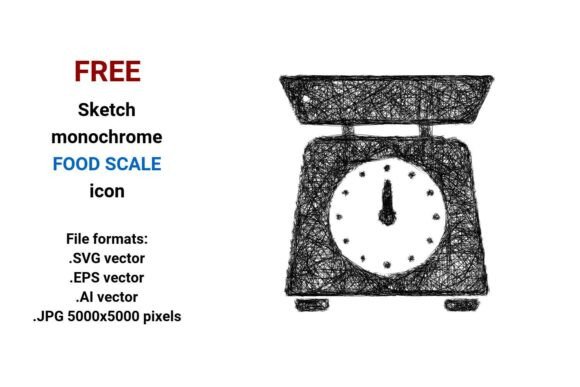
Designers, developers, and content creators often face a quiet but persistent challenge: finding icons that communicate precision without sacrificing personality. The FREE Sketch Food Scale Icon meets that need—not as a generic placeholder, but as a purpose-built visual tool rooted in clarity, scalability, and expressive restraint. It’s not just another food-related icon. It’s a handdrawn, sketch-style representation of a kitchen scale—deliberately minimal, intentionally imperfect, and technically robust across formats.
Why This Icon Fits Real Workflows
Unlike photorealistic or overly polished icons, the FREE Sketch Food Scale Icon carries subtle narrative weight. Its pencil-sketch aesthetic signals approachability, craftsmanship, and human intention—qualities that resonate in food blogs, meal-planning apps, nutrition dashboards, and kitchenware e-commerce sites. Because it’s delivered in four production-ready formats—.SVG vector, .EPS vector, .AI vector, and .JPG at 5000×5000 pixels—it adapts seamlessly to both digital interfaces and print collateral without pixelation or distortion.
A vector image isn’t just “scalable.” It’s mathematically defined: points, lines, curves, and fills governed by equations rather than fixed pixels. That means whether you’re embedding the FREE Sketch Food Scale Icon into a responsive web UI at 24px or printing it on a 24” product catalog banner, fidelity remains intact. No reworking. No quality loss. Just consistent, intentional communication.
Strategic Use Cases Across Roles
For educators and health professionals: When building lesson plans or patient handouts about portion control or macro tracking, this icon functions as a visual anchor—immediately recognizable, culturally neutral, and free of brand-specific associations. Its sketch style avoids clinical sterility while retaining accuracy, making complex concepts like “measure,” “kitchen scale,” or “food weighing” feel grounded and accessible.
For freelancers and small business owners: If you design landing pages for smart kitchen gadgets, subscription meal kits, or wellness coaching services, the FREE Sketch Food Scale Icon offers an efficient way to reinforce core actions—“scale,” “weigh,” “track”—without competing with your brand palette. Its black-and-white simplicity ensures legibility against any background, and its isolated, flat line-art composition integrates cleanly into SVG sprite sheets or Figma component libraries.
For developers and UI designers: As a vector food scale button, it supports accessibility when paired with proper ARIA labels and semantic HTML. Its clean outline and uncluttered structure reduce cognitive load—users instantly parse function over decoration. And because it’s available in .SVG and .AI, it can be edited directly in code (e.g., stroke width adjustments, dynamic color fills) or refined in design tools without raster degradation.
What to Consider Before You Use It
Not every context benefits from sketch-style iconography. Before deploying the FREE Sketch Food Scale Icon, ask: Does this support—or dilute—my message? In highly regulated environments (e.g., medical device documentation), strict adherence to ISO icon standards may supersede stylistic preference. In high-traffic SaaS dashboards where speed and universal recognition are paramount, a more standardized scale icon might perform better for first-time users.
Also consider consistency. If your interface uses bold, geometric icons elsewhere, introducing a handdrawn food scale icon—even a well-executed one—can create visual dissonance. That doesn’t mean it’s wrong; it means it requires deliberate integration. You might adjust stroke weights to match other icons, apply uniform corner radii, or use consistent negative space framing to unify the set.
Practical Integration Tips
- Pair with clear microcopy: An icon alone rarely conveys “kitchen scale” unambiguously. Use it alongside verbs like “Weigh,” “Measure,” or “Track portions” to anchor meaning—especially in mobile interfaces or multilingual contexts.
- Leverage format strengths: Use the .SVG version for web buttons and interactive elements (it supports CSS transforms and hover states); reserve the .JPG only for print mockups or social media previews where vector support isn’t guaranteed.
- Test contrast and scale: At small sizes (under 32px), fine hatch details in the sketch may blur or disappear. Preview the icon at actual usage sizes—and simplify manually if needed (e.g., removing interior shading lines for UI buttons).
- Respect licensing boundaries: Though labeled “FREE,” verify usage rights for commercial redistribution—especially if embedding in white-labeled software or selling templates that include the icon.
Risks of Using Without Context
Using the FREE Sketch Food Scale Icon without strategic alignment risks functional ambiguity. A sketch-style icon implies informality and creativity—but if your audience expects precision (e.g., professional chefs using a recipe scaling tool), that same informality may unintentionally signal inaccuracy. Similarly, overusing sketch aesthetics across an entire interface can dilute impact. One well-placed handdrawn food scale icon draws attention; ten scattered across a dashboard creates visual noise.
Another risk lies in assumption: that “free” equals “zero effort.” While the icon itself requires no license fee, thoughtful implementation does take time—testing contrast ratios, auditing accessibility, aligning with typography hierarchy, ensuring responsive behavior. Skipping those steps turns a valuable asset into a liability.
Long-Term Value Beyond the Download
The real value of the FREE Sketch Food Scale Icon isn’t just in its immediate utility—it’s in how it encourages intentionality. Choosing a sketch-style icon over a default one prompts reflection: What tone do we want to project? Who is interpreting this symbol—and what prior knowledge do they bring? That kind of questioning strengthens design decision-making muscle over time.
It also serves as a low-stakes entry point for exploring broader visual systems. Once you’ve integrated this icon successfully, you’ll be better equipped to evaluate other assets—not just on aesthetics, but on alignment with goals, audience expectations, technical constraints, and long-term maintainability. That discipline compounds: better icon choices lead to clearer user flows, which improve engagement, retention, and trust.
When to Choose This Over Alternatives
Opt for the FREE Sketch Food Scale Icon when:
- You’re designing for audiences that value authenticity over polish—home cooks, wellness coaches, educators, or artisanal food brands.
- Your project demands flexibility across formats and resolutions, and you need reliable vector fidelity without outsourcing to a designer.
- You want to emphasize action (“measure,” “weigh,” “track”) without overwhelming users visually—its flat, outline-based sketch food scale button form prioritizes function.
- You’re building reusable components (e.g., Figma libraries, React icon systems) and need a lightweight, editable, scalable base asset.
It’s less ideal when:
- Your brand guidelines mandate strict geometric consistency and prohibit organic linework.
- You’re developing for environments where icon recognition speed is critical and users aren’t familiar with sketch conventions.
- You need multicolor variants or animated states—and don’t have resources to adapt the base files yourself.
Final Thought: Tools Serve Strategy, Not the Other Way Around
The FREE Sketch Food Scale Icon is a capable, well-engineered tool—but like any tool, its effectiveness depends entirely on how thoughtfully it’s applied. It won’t fix unclear messaging, compensate for poor information architecture, or replace user research. What it can do is strengthen clarity, support consistent tone, and reduce friction in visual communication—when selected deliberately, tested rigorously, and aligned with real goals.
So download it. Test it at actual size. Try it in context—not as decoration, but as part of a system. Then decide: does it help people understand, act, or trust more easily? If yes, it’s earning its place. If not, set it aside and keep looking. Good design isn’t about collecting assets. It’s about choosing the right ones—intentionally, strategically, and with purpose.