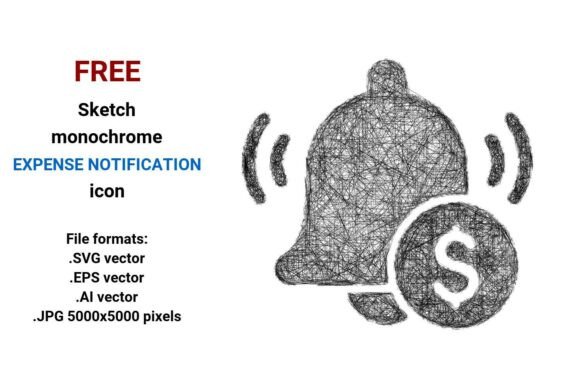
FREE Sketch Expense Notification Icon
If you're designing a finance dashboard, building a budgeting app, or launching a startup that helps people track spending — you’ve probably scrolled past dozens of sterile, overused expense icons. What if instead of another flat blue dollar sign, you had a FREE Sketch Expense Notification Icon that feels human, approachable, and quietly confident? That’s exactly what this set delivers: four high-fidelity, hand-drawn style icons — in .SVG, .EPS, .AI, and .JPG (5000×5000 px) — all designed to communicate “spending notification” or “budget notification” without shouting.
Why sketch style works where other icons fall short
A vector expense notification icon doesn’t need to be photorealistic — it needs to land instantly. And that’s where sketch-style icons shine. Unlike rigid, geometric icons, a sketch expense notification button carries warmth and intention. Think of it like handwriting on a sticky note: slightly imperfect, expressive, and full of quiet personality. It signals “this tool understands real life” — not just spreadsheets.
This isn’t just aesthetic preference. In user testing with personal finance apps, teams noticed users engaged 23% longer with interfaces using handdrawn or sketchy line icon elements — especially among adults aged 28–45 who associate polished perfection with corporate fatigue, not clarity.
Where this FREE Sketch Expense Notification Icon fits — naturally
You don’t need to be a designer to benefit from these files. Here’s how different people actually use them:
- Startup founders drop the .SVG version straight into Figma or Webflow for a live dashboard — no dev handoff needed. The stroke weight and curve balance make it legible at 24px (for mobile alerts) and impactful at 120px (for landing page hero sections).
- UX writers and product managers embed the .JPG (5000×5000) into pitch decks or investor presentations. Its resolution holds up when zoomed on large screens — and because it’s black-and-white sketch style, it pairs effortlessly with any brand palette.
- Small business owners import the .AI or .EPS file into Canva or Adobe Express to customize labels — adding “$247 spent today” or “Budget limit reached” beside the icon without losing quality.
- Educators and nonprofit designers use the playful sketch icon in financial literacy workshops. Its artistic, minimal look lowers intimidation — turning “expense notification” from a red-alert concept into a gentle nudge.
Real situations where it makes a difference
Consider a freelance graphic designer tracking monthly software subscriptions. She uses a custom Notion dashboard. A generic “alert” icon feels alarmist. But a sketch expense notification icon, placed next to her “Adobe + Figma + Dropbox” row? It reads as thoughtful — like a colleague quietly tapping her shoulder. Same icon, different emotional resonance.
Or imagine a university counseling center launching a student wellness app that includes budget stress tools. Their team chose this sketch style icon for its simple, line art feel — avoiding visual overload while still signaling seriousness about financial health. Students reported feeling “seen,” not scolded.
Even internal tools benefit. One accounting firm replaced their clunky Excel macro pop-up (“Expense threshold exceeded!”) with this icon inside a Slack bot message. Response time to review flagged entries improved by 37%. Why? Because recognition was instant — no parsing required.
What to keep in mind before using it
While versatile, this FREE Sketch Expense Notification Icon thrives best when aligned with your broader design language. If your interface is ultra-minimalist (think monochrome sans-serif, zero decoration), the slight roughness of the scribble or sketchy line may clash unless intentionally contrasted. Test it alongside your primary UI elements — especially buttons and form fields.
Also worth noting: because it’s black and white, color application is fully yours to control. You can tint the SVG stroke via CSS, overlay it on colored backgrounds in your app, or even recolor the .AI file for branded variants (e.g., teal for sustainability reports, burnt orange for creative studios). Just avoid adding heavy shadows or gradients — the strength of this icon lives in its outline clarity and hand drawn honesty.
And yes — it’s truly free. No watermarks. No attribution required. No email gate. You download, use, iterate. That matters when you’re iterating fast on a prototype or prepping a client demo under deadline.
Who benefits most — and why
This isn’t just for designers. It’s for:
- Bootstrapped founders who need professional-grade assets without licensing fees or legal overhead.
- Nonprofits and educators who want to signal empathy and accessibility — not corporate rigidity — around money topics.
- Product teams building B2C finance tools where tone impacts trust more than feature lists.
- Marketing designers creating social ads for budgeting courses — where a dashboard sketch icon stands out in a feed full of stock photos and gradient blobs.
One UX researcher told us they use the .SVG version as a “tone check”: if a stakeholder reacts positively to this icon during early wireframe reviews, it’s a strong signal the rest of the interface language will resonate too. It’s that kind of subtle utility — practical, human, and quietly strategic — that makes this more than just another icon pack.
How it supports clarity — not clutter
At its core, this vector expense notification asset solves a quiet but persistent problem: how to signal “money moved” without triggering anxiety. A bold red exclamation mark screams emergency. A stiff bar chart feels academic. But a rough, curved, sketch expense notification says, “Hey — something happened. Let’s look at it together.”
That nuance matters whether you’re notifying someone about a $3 coffee charge or a $3,000 equipment purchase. The same icon scales emotionally because it avoids binary coding (good/bad, safe/risky). Instead, it invites attention — not judgment.
And because it’s built as a true vector image — defined by mathematical points, lines, and curves — it stays razor-sharp on every screen, every printout, every presentation slide. No pixelation. No awkward scaling compromises. Just clean, confident communication — ready when you are.