FREE Sketch Customer Service Icon: A Strategic Asset for Clarity, Consistency, and Connection
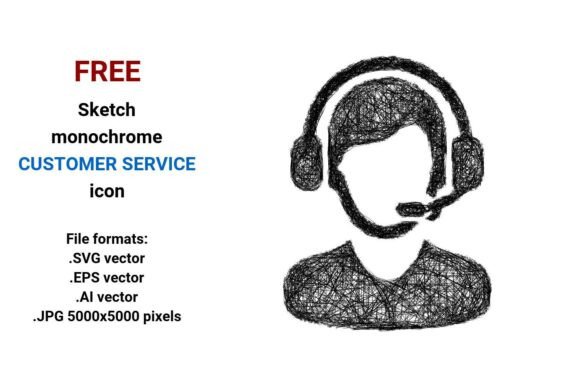
When your audience lands on a support page, clicks a contact button, or scans a help desk interface, they don’t read paragraphs first—they notice symbols. A well-chosen icon communicates intent faster than text. The FREE Sketch Customer Service Icon isn’t just another download—it’s a deliberately crafted visual tool designed to signal approachability, human-centered support, and thoughtful design. Available in four production-ready formats—.SVG vector, .EPS vector, .AI vector, and .JPG (5000×5000 pixels)—it bridges artistic expression with technical precision. Unlike pixel-based graphics that blur when enlarged, this is a true vector image: built from mathematical paths, infinitely scalable, and crisp at any size—from a mobile app button to a printed service manual.
Why “Sketch” Style Matters—Beyond Aesthetics
The hand-drawn, sketchy line quality isn’t decorative—it’s functional. In digital interfaces saturated with rigid, over-polished icons, a sketch customer service icon introduces warmth and authenticity. It subtly signals that real people—not bots or scripts—stand behind the service. That impression matters most when trust is fragile: during onboarding, after an error, or when users seek reassurance. For educators building learning platforms, freelancers designing client dashboards, or small business owners launching e-commerce sites, this tone alignment strengthens credibility without words.
This isn’t about “looking artsy.” It’s about strategic tonal calibration. A monochrome, hand drawn customer service icon supports minimal UI design systems, reduces visual noise, and ensures accessibility across devices and color schemes. Its line art simplicity means it integrates cleanly into dark mode, high-contrast settings, and print collateral—unlike complex, multi-layered illustrations that lose legibility at small sizes.
Where and When This Icon Delivers Real Value
Use the FREE Sketch Customer Service Icon where clarity, speed, and emotional resonance converge:
- Help desk navigation: As a primary tab or floating action button—its curved, sketchy lines guide the eye more naturally than sharp-cornered alternatives.
- Customer onboarding flows: Embedded in tooltips or step indicators to soften instructions and reduce perceived friction.
- Transport or logistics dashboards: Paired with route maps or status trackers, it reinforces human oversight amid automated systems—critical for field service teams or delivery platforms.
- Educational or nonprofit resources: Conveys openness and approachability in community support portals, volunteer coordination tools, or accessibility guides.
Crucially, avoid deploying it as generic decoration. If your support process is slow, unresponsive, or poorly documented, no icon—no matter how well-drawn—will compensate. The sketch customer service icon amplifies intention; it doesn’t replace it. Use it only when your underlying service infrastructure matches its promise of responsiveness and care.
Choosing the Right Format—Matching File Type to Purpose
Each included format serves a distinct role in your workflow:
- .SVG: Best for web use—lightweight, responsive, and editable via CSS. Ideal for buttons, navigation bars, and interactive elements where scaling and animation matter.
- .EPS and .AI: Industry-standard vector formats for designers using Adobe Illustrator or professional print workflows. Preserve layers, paths, and editability—essential if you need to adjust stroke weight, align with brand typography, or adapt for branded stationery.
- .JPG (5000×5000 px): High-resolution raster fallback for contexts where vector support is limited—think email clients, legacy CMS platforms, or printed presentations. Its size ensures clarity even when scaled down for thumbnails or embedded in PDF reports.
Don’t default to JPG just because it’s familiar. Using a raster file where vector is supported sacrifices scalability, increases load time, and limits customization. Ask: “Will this appear at multiple sizes? Will designers need to modify it?” If yes, start with SVG, EPS, or AI.
Integrating With Intention—Not Just Convenience
Strategic adoption begins before import. Consider these questions:
- Does it reinforce—or contradict—your existing visual language? If your brand uses bold, geometric icons, a delicate sketch line icon may feel disconnected unless intentionally introduced as a deliberate contrast (e.g., “human support” vs. “automated tools”).
- What action should it prompt? A customer service button needs clear affordance—sufficient size, contrast, and proximity to related content. Pairing the FREE Sketch Customer Service Icon with concise microcopy (“Chat now,” “Get help”) yields better outcomes than relying on the symbol alone.
- Is it accessible? Test contrast ratios against background colors. Ensure screen readers interpret it meaningfully—use
aria-labelattributes for SVG usage, and always provide context in surrounding text.
For bloggers and publishers embedding support links in long-form content, place the icon inline with explanatory sentences—not isolated in margins. For app developers, test tap targets: minimum 48×48px touch area, with padding between adjacent icons. These aren’t “design details”; they’re operational requirements for usability.
Risks of Misalignment—When “Free” Isn’t Enough
A free sketch customer service icon carries no inherent risk—but misapplication does. Common pitfalls include:
- Tone mismatch: Using a playful, pencil-drawn icon in a financial compliance portal may unintentionally undermine seriousness and authority.
- Overuse: Repeating the same sketch customer service icon across every page dilutes its meaning. Reserve it for moments where support relevance is highest—contact forms, error states, or account recovery flows.
- Ignoring context: Deploying it in a transport logistics dashboard without linking it to real-time driver support or ETA updates creates false expectations. The icon must connect to a functional outcome—not just look good.
“Free” doesn’t mean “zero-cost decision.” Every visual choice shapes perception. If your goal is to position your offering as premium, reliable, or highly regulated, evaluate whether a handdrawn vector icon supports that positioning—or inadvertently softens it.
Long-Term Value: From Asset to Anchor
The FREE Sketch Customer Service Icon gains compounding value when treated as part of a broader communication strategy—not a one-off download. Document its usage in your team’s design system: specify recommended sizes, spacing rules, color variants, and paired microcopy. Over time, consistency builds recognition. Users begin associating that specific sketchy line icon with dependable assistance—reducing cognitive load and increasing engagement.
For educators creating open educational resources, or nonprofits building multilingual support portals, this icon becomes a universal anchor—a recognizable symbol that transcends language barriers while retaining cultural neutrality. Its monochrome nature avoids unintended connotations tied to color psychology, making it adaptable across regions and audiences.
Ultimately, the power of the FREE sketch black and white customer service icon lies not in its availability, but in how deliberately you wield it. It works best when chosen—not because it’s free—but because it aligns with your goals, supports your users’ needs, and reflects the integrity of your service. That’s how a simple line icon becomes a quiet, consistent contributor to trust, efficiency, and long-term differentiation.