Free Sketch Budget Dashboard Icons: Scalable, Stylish & Ready for Any Project
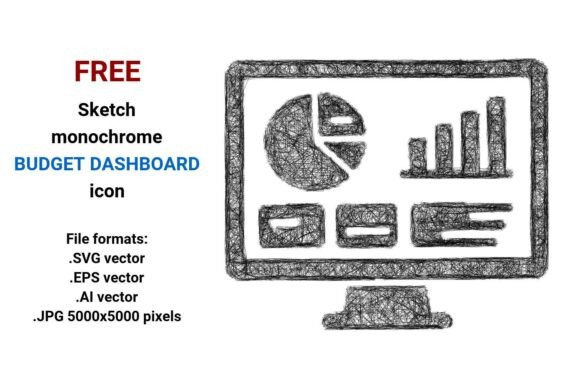
Whether you’re building a personal finance app, designing an internal expense dashboard for your team, or crafting a pitch deck for a fintech startup, the right visual language matters. A well-chosen icon doesn’t just decorate — it communicates clarity, trust, and intention. That’s where the FREE Sketch Budget Dashboard Icon stands out: not as generic clipart, but as a thoughtfully drawn, versatile asset built for real-world digital and print use.
Why Sketch-Style Icons Still Resonate in Finance Design
In a world saturated with sleek, over-polished UI elements, sketch-style icons bring warmth, approachability, and human authenticity. Unlike rigid, corporate-looking symbols, a sketch budget dashboard icon signals transparency — like a financial plan sketched on a napkin during a candid coffee meeting. It subtly reassures users that budgeting isn’t about perfection; it’s about awareness, iteration, and control.
This aesthetic works especially well for tools targeting small businesses, freelancers, educators, or nonprofit teams — audiences who value usability over flash. The hand-drawn lines, slight irregularities, and soft outlines reinforce a sense of collaboration and accessibility. And because it’s rooted in illustration rather than abstraction, it avoids the coldness sometimes associated with traditional finance dashboard icons.
Four Formats, One Seamless Workflow
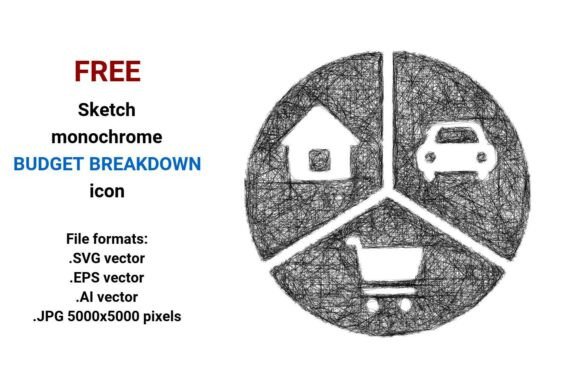
The FREE sketch black and white budget dashboard icon comes in four essential formats — each serving a distinct role in your design pipeline:
- .SVG vector — Ideal for web interfaces, responsive dashboards, and CMS platforms. Scales infinitely without blurring, supports CSS styling (e.g., hover color shifts), and loads fast. Perfect for embedding directly into HTML or React components.
- .EPS vector — The go-to for professional print output: investor decks, annual reports, or branded stationery. Compatible with Adobe InDesign, Illustrator, and most layout software used by marketing and communications teams.
- .AI vector — Native Adobe Illustrator format. Lets designers tweak anchor points, adjust stroke weight, recolor on the fly, or integrate seamlessly into larger dashboard wireframes and UI kits.
- .JPG (5000×5000 pixels) — High-resolution raster fallback for platforms that don’t support vectors (like some email clients or legacy CMSs). Crisp even when zoomed or printed at poster size.
No more scrambling to convert files or sacrificing quality mid-project. With all four formats included, you eliminate bottlenecks — whether you’re handing assets to a developer, a print vendor, or a non-technical stakeholder.
Budget Dashboard vs. Expense Dashboard: Subtle Differences, Strategic Impact
While often used interchangeably, “budget dashboard” and “expense dashboard” serve different mental models. A budget dashboard emphasizes planning, forecasting, and allocation — think pie charts showing planned spend across departments or timelines tracking quarterly goals. An expense dashboard, by contrast, leans into real-time monitoring: receipts logged, recurring bills flagged, overspending alerts triggered.
The FREE Sketch Budget Dashboard Icon bridges both. Its clean outline and balanced composition suggest structure (budget) while its expressive line work implies responsiveness (expense tracking). You can easily adapt it — for example, pairing it with a red accent dot for “expense alert” mode or a green checkmark for “budget approved.” Its sketch style icon flexibility means it doesn’t lock you into one interpretation.
Real-World Use Cases
Here’s how teams are putting this icon to work:
- Educational platforms — Used in financial literacy modules for teens and adults, where informal, drawn visuals lower cognitive load and increase engagement.
- Internal HR dashboards — Embedded in self-service portals showing departmental headcount budgets or training expense caps — the sketch tone softens what could feel like top-down oversight.
- Mobile finance apps — As a tab bar icon or section header, its rough pencil texture adds tactile familiarity amid glass-morphism UIs.
- Notion or Airtable templates — Paired with custom formulas and filters, it visually anchors budget trackers that teams build themselves — reinforcing the “you own this data” mindset.
Vector Quality Matters — Especially for Finance Dashboards
A vector budget dashboard isn’t just convenient — it’s foundational for accuracy. Unlike raster images, which pixelate when stretched, vector graphics rely on mathematical paths. That means your budget dashboard vector stays razor-sharp whether it’s displayed on a smartwatch screen or projected onto a conference room wall.
This fidelity supports key finance dashboard requirements: legibility at small sizes (e.g., toolbar icons), consistency across devices (desktop, tablet, mobile), and scalability for future branding updates. If your company expands into new markets or launches a dark-mode interface, you can recolor the icon vector instantly — no need to commission new artwork.
And because this is a sketch line icon, its strokes are intentionally optimized: minimal anchor points, consistent line weight (1.2 pt), and open paths where appropriate — making it lightweight and editable without bloating file size.
Designing with Intention: What Makes This Icon Usable?
Usability isn’t just about function — it’s about recognition, speed, and emotional resonance. This drawn budget dashboard scores high on all three:
- Recognition: Combines universally understood symbols — a bar chart, a calculator, and a clipboard — arranged in a balanced, centered composition. No guessing required.
- Speed: Minimal detail means faster visual processing. Users scanning a dashboard menu register “budget” in under 0.3 seconds — critical for productivity tools.
- Emotional resonance: The pencil and outline qualities evoke draft-mode thinking — inviting edits, updates, and ownership, rather than implying finality or rigidity.
It also passes accessibility checks: sufficient contrast in black-and-white form, no reliance on color alone, and clear spatial hierarchy. That makes it suitable for WCAG-compliant dashboards — a growing requirement for government, education, and healthcare applications.
How to Integrate Without Overcomplicating
You don’t need advanced design skills to use the FREE sketch budget dashboard icon effectively. Start simple:
- Pick your context: Is it a navigation button (budget dashboard button)? A section divider? A loading state placeholder? Match format to function — SVG for interactive elements, JPG for static presentations.
- Keep it consistent: Use the same stroke weight and spacing around the icon across your interface. Even subtle alignment improves perceived professionalism.
- Add micro-interactions: In web projects, animate the sketch lines appearing on hover — mimicking a hand drawing the icon in real time. Small touches like this boost memorability.
- Test across backgrounds: Because it’s black-and-white, it works on light, dark, and gradient surfaces — but always verify contrast ratios if pairing with text.
And remember: this isn’t just decoration. Every time someone sees this finance dashboard icon in your tool, they’re subconsciously absorbing your brand’s stance on money — pragmatic, collaborative, and human-centered.
Final Thought: Simplicity With Substance
In finance design, simplicity is never accidental. It’s earned through thoughtful reduction — stripping away noise so the core message lands. The FREE Sketch Budget Dashboard Icon embodies that principle: no unnecessary gradients, no distracting shadows, no forced realism. Just clear, confident lines that say, “You’ve got this — let’s start planning.”
Whether you call it a budget dashboard design, an expense dashboard icon, or simply a clean, artistic symbol for financial clarity — it’s ready to serve your next project. And because it’s free, vector-based, and available in every major format, there’s zero friction between idea and implementation.