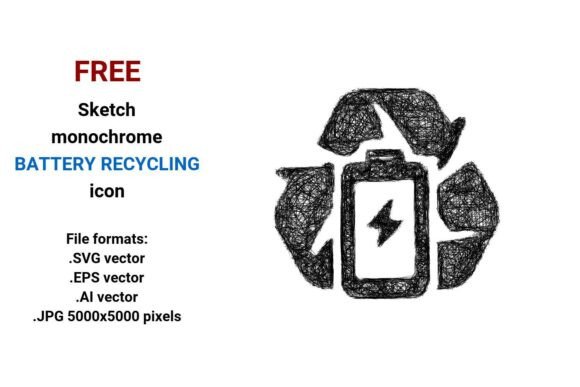
FREE Sketch Battery Recycling Icon
If you’ve ever tried to design a clean, trustworthy visual for an eco-conscious project—whether it’s a school poster on sustainability, a startup’s EV recycling landing page, or a community workshop handout—you know how hard it is to find an icon that feels both professional and human. That’s where the FREE Sketch Battery Recycling Icon stands out: not as a sterile corporate symbol, but as a warm, approachable, hand-drawn line sketch that communicates care, action, and intention—without sacrificing clarity or scalability.
What It Is (and Why It Feels Different)
This isn’t just another battery icon with a recycling arrow slapped on top. The FREE Sketch Battery Recycling Icon is drawn like someone sketched it with purpose—slight line variation, gentle tapering, subtle imperfection. It’s minimal but not cold; playful but not childish; rough enough to feel authentic, yet precise enough to work in UI, print, or branding. And because it’s delivered in four formats—.SVG vector, .EPS vector, .AI vector, and a high-res .JPG (5000×5000 pixels)—you’re covered whether you’re editing in Figma, prepping a brochure in InDesign, building a web button, or printing a large-format banner.
Where It Actually Gets Used (Not Just “Could Be Used”)
Think about real moments—not hypothetical ones. A high school science teacher prints the FREE Sketch Battery Recycling Icon on laminated cards for a hands-on sorting activity: students match batteries to recycling stations while recognizing the icon in context. No jargon needed. Just recognition, repetition, and relevance.
A freelance UX designer drops the SVG version into a dashboard for an EV fleet management platform. It sits beside labels like “Battery Health,” “Reuse Status,” and “Recycling Path”—not as decoration, but as intuitive visual shorthand. Users glance and understand instantly: this is where battery reuse decisions happen.
A small business owner launching a local battery take-back program adds the sketch icon to their Instagram Stories, website banner, and printed bin labels. Because it’s available in black-and-white, it works equally well on a matte paper flyer and a glossy storefront decal—no color matching headaches, no pixelation when scaled up.
Who Benefits—and How It Fits Their Real Work
- Educators & Students: The sketch style lowers cognitive load—especially for younger learners or non-native English speakers. Paired with simple text (“Drop here. Reuse starts now.”), it builds familiarity with battery reuse concepts without overwhelming visuals.
- EV Startups & Sustainability Teams: When explaining complex ev recycling workflows—like lithium recovery or second-life applications—a friendly, human-made icon softens technical messaging. It signals transparency, not salesmanship.
- Bloggers & Content Creators: Need a consistent visual thread across a series on sustainability? This icon scales cleanly from a tiny social media avatar to a full-width header image. No need to hunt for new assets every time.
- Local Governments & NGOs: Municipal recycling campaigns often suffer from generic clipart fatigue. This sketch icon reads as locally grounded—not outsourced, not stock, but thoughtful. It pairs naturally with photos of real people handling batteries at collection events.
Why Vector Matters (Beyond “It Scales”)
Saying “it’s a vector” sounds technical—but what it really means is flexibility without compromise. You can stretch the .SVG version to fill a mobile screen button and still see every curve of the battery outline. You can open the .AI file and recolor the sketch in your brand palette—no raster artifacts, no fuzzy edges. You can embed the .EPS in a PDF report and know it’ll stay crisp when printed on recycled paper at 300 DPI. And that .JPG (5000×5000)? It’s your fallback for platforms that don’t accept vectors—like certain email clients or legacy CMS systems—without sacrificing resolution.
This isn’t about having options for the sake of it. It’s about removing friction between idea and execution—so you spend less time wrestling with assets and more time focusing on what the icon represents: responsible battery stewardship, practical recycling, and real-world sustainability.
Things to Consider Before You Use It
Even free, well-made icons need thoughtful application. Ask yourself:
- Is contrast clear in your medium? The black-and-white sketch relies on strong value separation. Test it against your background—especially if using it on textured surfaces or low-contrast digital interfaces.
- Does it align with your tone? A playful, hand-drawn icon may feel mismatched next to ultra-minimalist, geometric branding. But it shines alongside photography, handwritten type, or earthy color palettes—where authenticity matters more than polish.
- Are you representing accurate processes? An icon shouldn’t oversimplify. Pair it with brief, factual context—e.g., “This battery will be tested for reuse in energy storage” or “Recovered materials go back into new battery production.” The icon invites attention; the words build trust.
More Than an Icon—A Small Act of Alignment
Choosing the FREE Sketch Battery Recycling Icon isn’t just about checking a design box. It’s a quiet signal: you care about how things are made, used, and retired. Whether you’re designing a municipal battery recycling campaign, building educational tools for ev recycling, or simply trying to make your small business’s values visible—it meets people where they are: curious, cautious, and looking for sincerity over slickness.
And because it’s truly free—no watermarks, no attribution required, no hidden tiers—you keep full creative control. No licensing guesswork. No last-minute asset swaps. Just a clean, scalable, human-centered tool ready when you are.
That’s the kind of resource that doesn’t just sit in a folder. It gets used. Shared. Printed. Clicked. Recognized. And eventually—like the batteries it represents—it finds its next useful life.