FREE Sketch Base Icon: Scalable, Artistic & Ready to Use
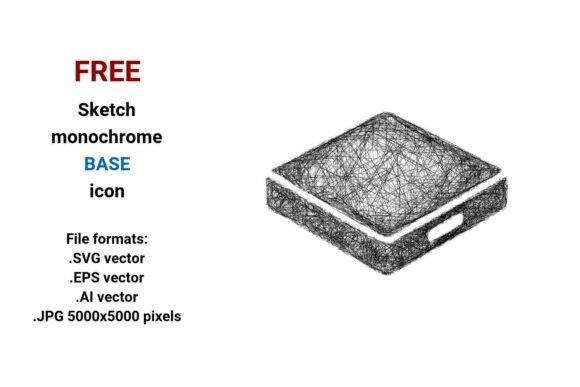
FREE Sketch Base Icon is a collection of hand-drawn, monochrome base icons designed specifically for baseball and field-related visuals — but flexible enough for broader creative or interface use. Each icon comes in four fully editable, high-resolution formats: .SVG, .EPS, .AI, and .JPG (5000×5000 pixels). Unlike pixel-based graphics, these are true vector images — built from mathematical paths, not fixed pixels — so they scale cleanly from a tiny app button to a wall-sized presentation without blurring, jagged edges, or quality loss.
Why This Matters — Depending on Who You Are
What makes FREE Sketch Base Icon valuable isn’t just its format variety or black-and-white aesthetic — it’s how that combination solves real problems across different roles and experience levels. A graphic designer, a P.E. teacher building a lesson plan, or a small business owner launching a local sports camp all interact with the same files — but their priorities, workflows, and definitions of “useful” differ sharply.
For Beginners & Educators
If you're new to design tools or teaching youth baseball, simplicity and clarity matter most. The sketch-style base icon avoids sterile clipart while staying instantly recognizable — no confusing abstractions. Its black-and-white, line-art nature makes it easy to print on handouts, trace on whiteboards, or import into beginner-friendly tools like Canva or Google Slides. Since the .JPG version is crisp at 5000×5000 pixels, it holds up even when enlarged on classroom projectors. Educators often pair it with labels or arrows in simple diagrams to explain base paths, tagging rules, or field positioning — all without needing Illustrator expertise.
For Designers & UI/UX Professionals
You likely care about integration, consistency, and scalability. The .SVG and .AI versions let you recolor, resize, and layer elements directly inside Figma, Adobe XD, or Illustrator — preserving stroke weight and sketch texture at any dimension. Because it's a vector base icon drawn with intentional roughness (not auto-traced), it fits naturally into modern interfaces that value human-centered, approachable aesthetics — think sports apps, coaching platforms, or community league websites. The .EPS file ensures compatibility with legacy print workflows, while the monochrome palette guarantees accessibility and fast loading times.
For Freelancers & Small Business Owners
You need speed, reliability, and commercial flexibility — without hidden costs or legal friction. FREE Sketch Base Icon is truly free to download and use, including in client projects and branded materials (always check the included license, but standard use covers most commercial contexts). No attribution required. That means you can drop the .SVG into a website header, embed the .JPG in a social media ad, or customize the .AI file to match your client’s brand colors — all in under two minutes. For seasonal campaigns (e.g., spring baseball registration), having a polished, field-ready base icon saves hours over commissioning custom artwork.
For Hobbyists & Content Creators
Your goal might be expressive, personal, or experimental — not production-perfect. The sketchy, hand-drawn quality invites modification: add watercolor overlays, stitch textures, or collage it into analog-style zines or Instagram stories. Because it’s available as both vector and high-res raster (.JPG), you’re not locked into one workflow. Try tracing over the .JPG with Procreate for a layered digital sketch, or import the .SVG into Inkscape to tweak anchor points and exaggerate the “rough” feel. It’s not just an icon — it’s a starting point for artistic reinterpretation.
How Format Choice Fits Your Real-World Needs
Not every format serves every purpose — and knowing why helps you choose wisely:
- .SVG: Best for web use — responsive, lightweight, supports CSS styling and animation. Ideal for buttons, navigation icons, or interactive field diagrams.
- .AI: Full editability in Adobe Illustrator — adjust strokes, expand sketches, combine with other vectors, or export custom variants.
- .EPS: Reliable cross-platform vector support, especially for older print software or service bureaus requiring CMYK prep.
- .JPG (5000×5000): Highest-quality raster fallback — perfect for presentations, printed posters, or platforms that don’t accept vectors (like some email builders or LMS dashboards).
This multi-format access removes common roadblocks: no more stretching low-res PNGs until they pixelate, no more converting files and losing fidelity, no more licensing guesswork. It’s practical infrastructure — quietly supporting better output.
When FREE Sketch Base Icon Is the Right Fit
It shines when you need authenticity without complexity — a baseball base that feels grounded and human, not robotic or generic. It works well if you value:
- Creativity over rigidity: You want room to adapt, not just copy-paste.
- Clarity over decoration: The sketch style communicates function first — ideal for instructional or functional contexts.
- Speed without sacrifice: You’re balancing tight deadlines with visual integrity.
- Long-term reuse: Vector files stay relevant across devices, screen sizes, and future projects.
It’s less ideal if you need photorealistic rendering, full-color gradients, or animated sequences — those require different assets altogether. But for clean, scalable, expressive base representation — whether for a school poster, a mobile app icon, or a coaching worksheet — FREE Sketch Base Icon delivers focused utility.
A Tool That Grows With You
What starts as a simple download can evolve with your skills and goals. A student might use the .JPG for a class presentation today — then later open the .SVG in Figma to learn how vectors behave. A marketer may begin by inserting the icon into a Canva template, then graduate to editing the .AI file to build a full set of custom field icons. Even seasoned designers appreciate having a trustworthy, stylistically cohesive base icon ready when inspiration strikes or deadlines loom.
At its core, FREE Sketch Base Icon respects your time, your intent, and your voice — whether you're explaining base running to ten-year-olds or designing the next generation of sports engagement tools. It doesn’t shout. It supports. And it scales — literally and meaningfully.