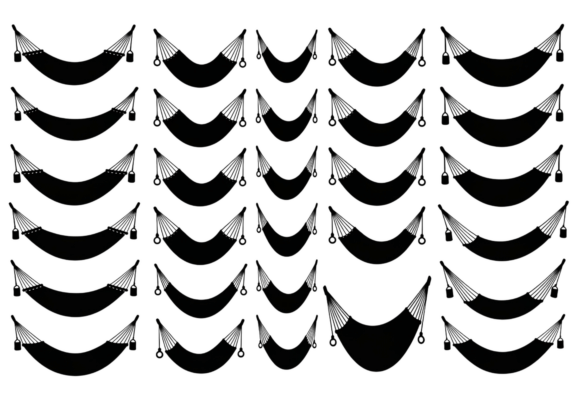
Black Hammock Silhouette Vector Clipart: A Precision Design Asset for Diverse Creative Workflows
Vector-based silhouette artwork occupies a distinctive niche in digital design—bridging minimalism with high functionality. Among such assets, the Black Hammock Silhouette Vector Clipart stands out not for its visual complexity, but for its intentional simplicity, technical fidelity, and cross-platform adaptability. Unlike raster images that degrade when scaled, this vector clipart maintains razor-sharp edges at any dimension—making it equally viable for a 2-inch enamel pin badge or a 10-foot wall decal. Its monochromatic black form eliminates color-matching variables, allowing designers to focus on placement, composition, and context rather than hue calibration.
Why Vector Silhouettes Remain Indispensable Across Disciplines
Silhouettes distill subjects into their most essential outlines—stripping away texture, shading, and detail to emphasize shape, proportion, and gesture. In education, a black hammock silhouette can illustrate principles of balance, tension, and suspension in physics lessons. In therapeutic art settings, its gentle, organic curve supports mindfulness-based drawing exercises without overwhelming cognitive load. For product designers, it serves as a clean placeholder in mockups—representing relaxation, outdoor leisure, or ergonomic rest—without competing with branding elements.
This functional neutrality is amplified by the vector format. Unlike JPEGs or PNGs, vectors store geometry as mathematical paths—not pixels. That means every curve, anchor point, and stroke in the Black Hammock Silhouette Vector Clipart is defined by coordinates and Bezier handles. The result? Full editability: users can adjust curvature, extend hanging ropes, isolate individual components (e.g., the hammock body versus support straps), or reposition anchor points—all without quality loss. This isn’t just convenience; it’s foundational flexibility for iterative design.
Hobbyists and Home Crafters
For makers using Cricut or Silhouette machines, the included SVG file delivers plug-and-play compatibility. No tracing, no node cleanup—just import, resize, and cut. Users report successful results on diverse materials: heat-transfer vinyl for custom t-shirts, thin balsa wood for miniature dioramas, and even adhesive-backed cork for rustic kitchen wall art. Because the silhouette uses single-path, non-overlapping strokes, cutting machines interpret contours accurately—even at sub-1-inch sizes—reducing material waste and blade recalibration.
Educators and Curriculum Developers
Teachers integrate the Black Hammock Silhouette Vector Clipart into printable worksheets on symmetry (folding along the central axis), scale modeling (comparing real hammock dimensions to scaled-down versions), or environmental science (mapping ideal tree spacing for safe hammock setup). The EPS and AI files allow educators to ungroup elements and label parts—ropes, spreader bars, suspension points—for anatomical-style diagrams. Since the file is editable in free or low-cost tools like Inkscape (via EPS import), accessibility isn’t limited to Adobe subscribers.
Small Business Owners and Print-on-Demand Sellers
Commercial use rights empower entrepreneurs to embed the silhouette into scalable product lines: embroidered patches for outdoor apparel brands, laser-engraved coasters for boutique cafes, or layered acrylic keychains. One case study from a Pacific Northwest gift shop showed a 37% lift in seasonal “backyard relaxation” bundle sales after incorporating the hammock silhouette across packaging, social media banners, and in-store signage. Crucially, the AI source file enabled rapid customization—adding subtle mountain silhouettes behind the hammock or integrating client logos into rope textures—without outsourcing design work.
UX/UI and Marketing Designers
In digital interfaces, minimalist icons improve scannability and load speed. The black hammock silhouette functions effectively as a category icon for wellness apps (“Rest Mode”), travel platforms (“Camping Essentials”), or furniture e-commerce filters (“Hanging Seating”). Its consistent stroke weight and balanced negative space ensure legibility at 24px on mobile screens. Designers using Figma or Sketch can import the SVG directly, then apply dynamic color overrides or motion effects—such as gentle sway animation via CSS transforms—to enhance engagement without sacrificing performance.
Technical Advantages Embedded in the File Suite
The inclusion of three complementary formats—SVG, EPS, and AI—addresses distinct workflow needs rather than serving as redundant backups:
- SVG: Optimized for web and cutting machines. Contains embedded metadata, preserves layer structure, and supports CSS styling when used inline in HTML.
- EPS: Ensures backward compatibility with legacy print workflows and older versions of CorelDRAW or Affinity Designer. Its PostScript foundation guarantees precise rendering on professional RIP (Raster Image Processor) systems used in large-format printing.
- AI: The native Illustrator file retains all original layers, swatches, and appearance attributes. Designers can swap global colors, apply gradient meshes to simulate fabric drape, or use the Shape Builder tool to create modular variants—like a hammock with detached pillows or adjustable height markers.
Each file undergoes manual path optimization: unnecessary anchor points are reduced, overlapping segments are resolved, and open paths are closed where appropriate for cutting integrity. This attention prevents common issues like “ghost cuts” (unintended internal lines) or inconsistent stroke behavior across software versions—a frequent pain point with auto-traced raster imports.
Workflow Integration: From Concept to Physical Output
Consider a typical implementation sequence for a wedding stationery designer creating eco-conscious invitations:
- Concept phase: Sketch layout with paper mockup; place Black Hammock Silhouette Vector Clipart as a central motif representing “relaxed celebration.”
- Digital refinement: Import AI file into Illustrator, change fill to soy-based ink Pantone 7497 C, then use Width Tool to subtly taper rope ends—enhancing realism without compromising cuttability.
- Production prep: Export optimized SVG for laser-cutting bamboo veneer inserts; export high-res PDF/X-4 from EPS for letterpress plates.
- Quality assurance: Test cut on scrap material at 80% power/2mm/s speed; verify rope thickness matches physical thread gauge (0.8mm).
This end-to-end control—enabled by clean vector construction—eliminates guesswork. There’s no need to hire a vectorizer, negotiate licensing for third-party assets, or troubleshoot pixelated exports. The asset behaves predictably because its construction adheres to industry-standard vector hygiene practices.
Considerations for Ethical and Effective Use
While the Black Hammock Silhouette Vector Clipart offers broad utility, responsible deployment requires contextual awareness. In healthcare communications, avoid pairing the silhouette with text implying passive rest for populations managing chronic fatigue—where activity pacing guidance is nuanced. In educational materials targeting young children, consider supplementing the silhouette with labeled safety icons (e.g., “tree trunk width > 12 inches”) to reinforce practical application.
Additionally, vector simplicity carries implicit assumptions: the design reflects a standard spreader-bar hammock, not a gathered-end or Mayan style. Users adapting it for technical documentation should verify proportions against real-world measurements—especially if illustrating load-bearing specifications. The file provides a strong starting point, not a substitute for domain-specific validation.
Future-Proofing Through Format Agility
As design ecosystems evolve—whether through browser-native vector rendering (SVG 2), generative AI-assisted customization, or AR-enabled preview tools—the underlying vector structure ensures longevity. An SVG file generated today renders identically in Safari 2024, Chrome 2030, or a future WebXR viewer. Unlike bitmap assets that require multiple resolutions (1x, 2x, 3x), one well-constructed vector scales seamlessly across devices, resolutions, and interaction modes. This isn’t theoretical efficiency—it’s measurable reduction in asset management overhead, version control conflicts, and storage bloat.
Ultimately, the Black Hammock Silhouette Vector Clipart exemplifies how rigorously built digital assets serve as quiet enablers: invisible infrastructure that empowers clarity, consistency, and creativity across disciplines. Its value emerges not in isolation, but in how effortlessly it integrates—supporting physics lessons, small-batch manufacturing, inclusive UX patterns, and classroom storytelling with equal precision. When the technical foundation is sound, the creative outcome becomes inevitable.